

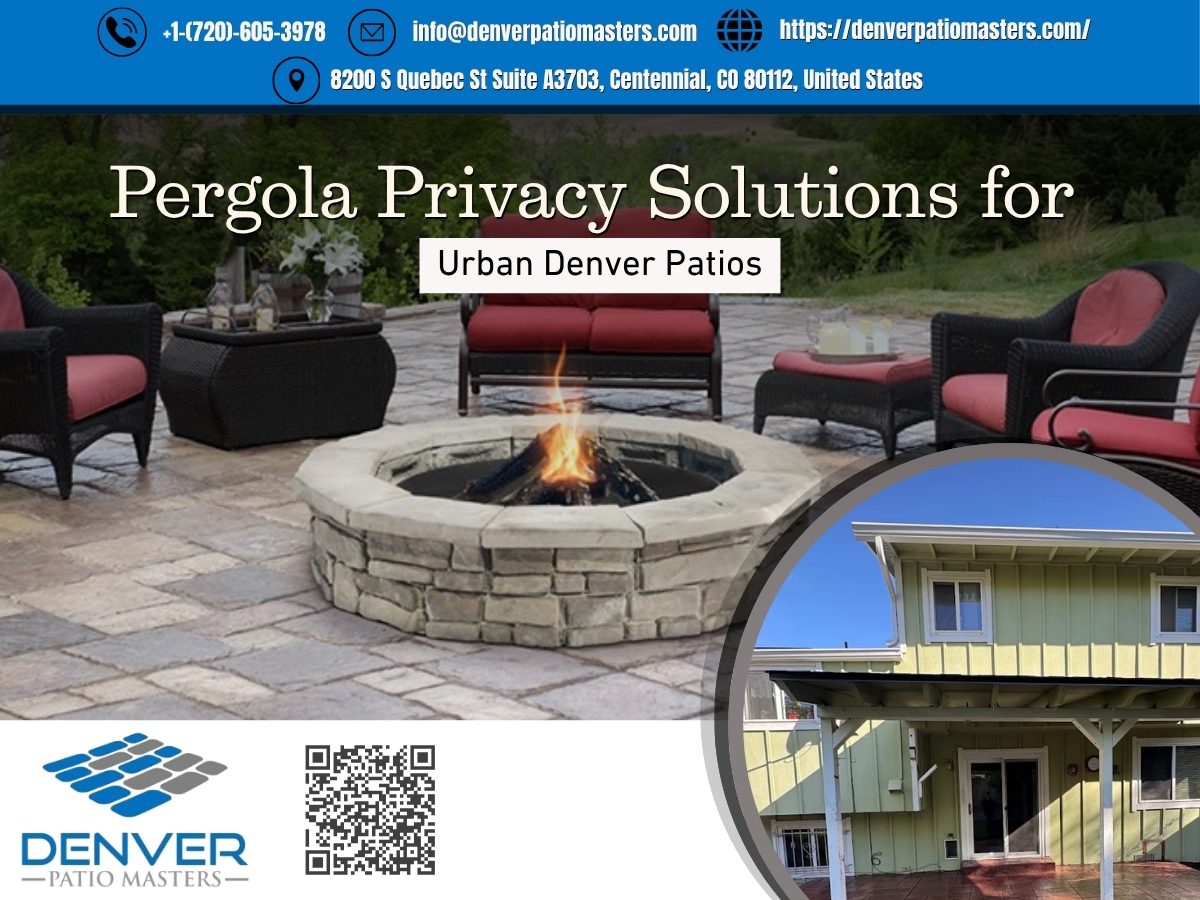
How do you add privacy to a pergola when your neighbor’s second-story window looks straight into your backyard? It’s one of the questions we hear most from homeowners in tighter Denver neighborhoods, and it’s a fair one. A pergola is supposed to feel like an escape, not a stage.
We’ve built pergolas across the Denver metro area, from older neighborhoods with narrow side yards to newer developments where fences sit just a few feet apart. As a reliable patio contractor in Denver, we know privacy isn’t a one-size-fits-all answer in any of these settings.
It depends on where the sun falls, where your neighbor’s windows sit, and how much airflow you want to keep. Here’s how our team approaches it and why each option works a bit differently.
How Close Lots Change the Way We Design a Pergola
When homes sit close together, the biggest design shift is thinking in terms of sightlines rather than square footage. A pergola that works beautifully on a half-acre lot with distance on every side won’t automatically translate to a narrow city yard.
Our team looks at where a second-story window sits relative to your patio, where the afternoon sun comes from, and which direction gets the most foot traffic from neighboring yards.
This is also where homeowners get surprised. Privacy issues aren’t always about the yard directly next door. Sometimes it’s a home behind you or a window at an angle you wouldn’t expect. We walk the property with you before design starts so we can flag those angles early, rather than finding them once the pergolas are built.
Louvered Panels and Adjustable Slats
Louvered pergola panels are one of the most requested privacy features we install, and it’s easy to see why. Unlike a solid wall or a fixed roof, louvers let you control shade, airflow, and visibility with a simple adjustment, either by hand or with a motorized system. On a warm afternoon, you can open them for a breeze. In the evening, when a neighbor’s patio lights turn on, you can close them down for a more enclosed feel.
These panels also handle Colorado’s shifting weather well. Since louvers can close fully, they double as light rain protection without turning an open-air pergola into a permanent roof structure. The way we angle and finish the slats also comes down to style. Some homeowners lean toward a modern vs. traditional pergola look, and that choice shapes where we place the panels so the space doesn’t feel boxed in.
Privacy Screens, Lattice, and Fabric Panels
Not every privacy solution needs to be mechanical. Lattice panels, whether left natural or painted to match your pergola’s finish, are a straightforward way to block a direct line of sight while still letting light and air move through.
They also give climbing plants something to grow on, which we’ll get into next. For homeowners who want something more finished, a slatted wood or composite screen panel can match the pergola’s posts and beams for a built-in look.
Fabric panels and outdoor curtains are another option we install often, especially for clients who want flexibility. These can be pulled closed on one side during the day and opened back up in the evening. They’re also budget-friendly, since they don’t require the same structural planning as a fixed screen.
It’s one of several benefits of adding a pergola that homeowners don’t always expect going in. The trade-off is durability in high wind, so we talk through fabric weight and mounting hardware first.
| Option | Privacy Level | Best For |
|---|---|---|
| Louvered panels | Adjustable, full to open | Homeowners who want control over shade and sightlines |
| Lattice or slatted screen | Partial, filtered | A built-in look that still lets light through |
| Fabric panels or curtains | Adjustable, softer | Budget-conscious, flexible privacy |
| Climbing plants | Grows in over time | A natural look homeowners are willing to wait for |
Feel like your patio is on display every time a neighbor’s window lights up? Give us a call at (720) 594-0235, and we’ll take a look at your sightlines before you invest in the wrong fix.
Using Plants and Greenery to Soften Sightlines
Greenery is often the most natural-looking privacy solution, and it tends to age better than people expect. Climbing vines trained along a pergola’s beams, like clematis or trumpet vine, can fill in a sightline within a couple of growing seasons without ever feeling like a wall was dropped into the yard.
We often pair these structures with a lattice or trellis insert built into the frame, which gives the plant something sturdy to climb.
Tall potted grasses, arborvitae, or a row of large shrubs along the property line can do similar work at ground level, especially where a neighbor’s patio sits lower or at an angle to yours. Plant-based privacy changes with the seasons, which some homeowners prefer.
The tradeoff is patience, since a living screen takes time to fill in, so we usually pair it with a faster option in the meantime.
Placement, Orientation, and HOA Considerations
Where a pergola sits on the property, and which direction it faces, often solves half the privacy problem before a single panel goes up. Turning the structure a few degrees, or shifting it a couple of feet closer to the house, can remove a direct sightline without adding any extra material.
This is part of why we spend real time on site orientation during design instead of treating placement as an afterthought.
If your property is in an HOA community, privacy additions like screens or taller structural elements sometimes need approval before installation. Our team manages that process directly with the association, so you aren’t the one tracking down forms or waiting on committee meetings. We build the approval timeline into the project schedule from the start.
Frequently Asked Questions
Does adding privacy panels to a pergola reduce airflow too much?
It depends on the option. Louvered panels and lattice keep air moving even when closed, while solid fabric panels reduce airflow more noticeably. We help you weigh this based on how you plan to use the space.
Can privacy screens be added to a pergola we already have?
In most cases, yes. Lattice inserts, fabric panels, and louvered sections can often be retrofitted onto an existing frame, though the structure needs to be sound enough to support the added weight, which we assess during a site visit.
How long does it take for plants to provide real privacy on a pergola?
Most climbing vines take one to two growing seasons to fill in meaningfully. We usually recommend combining greenery with a faster privacy option in the meantime.
Do I need HOA approval to add a privacy screen to my pergola?
It depends on your community’s rules and how visible the addition is from the street. We check this during planning and handle the approval process directly if it’s needed.
Talk to Our Team About Pergola Privacy
If your backyard feels a little too visible to the neighbors, we’d like to walk the space with you and talk through which option fits best. The right combination usually comes down to sun direction, lot size, and how you want to use the space.
Visit our contact page to schedule a free design consultation.
Address: 8200 S Quebec St, Suite A3703, Centennial, CO 80112
Phone: (720) 594-0235
Email: info@denverpatiomasters.com
Business Hours: Monday–Sunday: 9:00 AM–5:00 PM
Resources:
Pergola Privacy Solutions for Urban Denver Patios?
— Denver Patio Masters (@denverptmt) October 2, 2026
✨Learn more: https://t.co/oLtgnhQLy1
📍Find us: https://t.co/vwyLDLWADa#DenverPatioMasters #ReliablePatioContractorInDenver #PatiosNearMe #ConcreteRepairNearMe pic.twitter.com/dL3HSdfYrp