

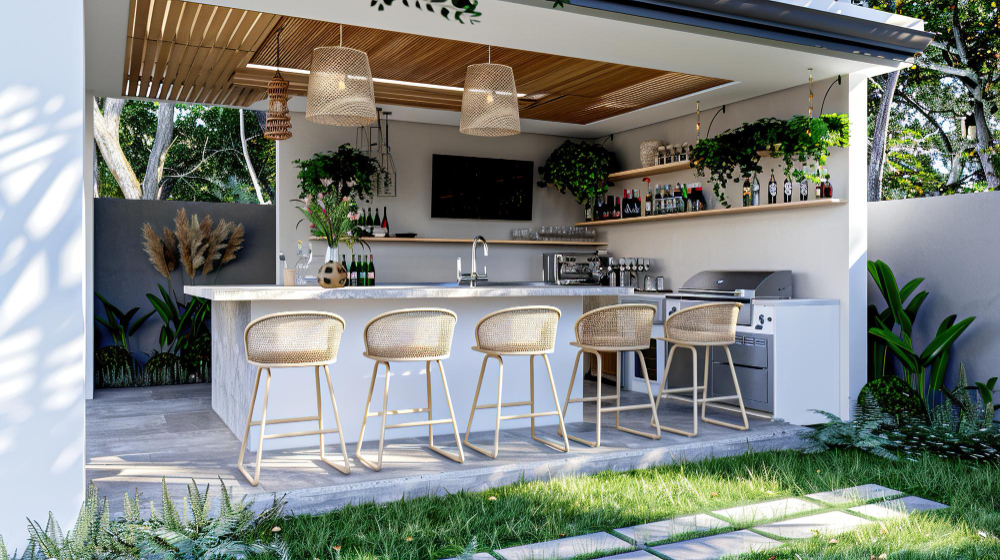
Nearly every connected feature in an outdoor kitchen depends on something buried under the patio. The real decisions happen weeks before anyone shops for a grill. Power, gas, water and a reliable signal all get placed during rough in, and none of them are cheap to add once the slab has cured.
We build these spaces as an affordable patio company in Denver, CO, and our design consultation maps the utility runs before the layout is finalized. The homeowners who end up happiest decided early what they actually wanted to control from a phone.
What Counts as a Smart Outdoor Kitchen
The category covers more ground than the marketing suggests. At the simple end sit app connected to grills that report internal meat temperature to a phone. Probe systems do the same for an existing grill without replacing it. At the other end sit refrigeration units that alert on temperature drift, ice makers on timers and pizza ovens with managed heat curves. Lighting and audio tie into whatever platform runs the rest of the house.
Useful is not the same as impressive, and a probe that tells you when a brisket has stalled saves a real evening. A connected ice maker rarely changes anyone’s life. Our crews have built kitchens with almost no technology in them, and others wired right to the roofline. The satisfied ones share a trait: every connected feature answered a question the homeowner had already been asking.
Power and Data Decide What You Can Install
Circuit planning is where most retrofit regret originates. A refrigerator, an ice maker, a warming drawer, task lighting and an outlet all add up quickly. An outdoor kitchen fed from a single convenience circuit will trip on the exact evening you have guests. Dedicated circuits with weather rated enclosures and ground fault protection are the baseline, sized against the appliance list rather than a guess.
Signal is the other half, and it gets ignored routinely, since household wifi weakens through exterior walls and dies behind masonry. A connected appliance twenty five feet past the back door may show full bars in spring. It can drop out once the yard fills with leaves.
Running conduit for an access point during construction costs very little, while adding it afterward means trenching a finished patio. Drainage belongs in the same conversation, and our piece on outdoor kitchen drainage in Denver explains how water movement shapes where equipment can sit before you commit to a layout.
Running gas and a water line out to an island before the first hard freeze? Give us a call at (720) 821 0467, and we will get the shutoff, the drain point and the altitude setup sorted while the ground is still open.
The Order to Decide Things In
Sequence keeps a build from backing itself into a corner. Working through these in order lets each decision inform the next instead of contradicting it.
- Decide how you cook. Grill only, or grill plus side burner, pizza oven, smoker and refrigeration.
- List the appliances. Model numbers, not categories, since clearances and cutout dimensions vary.
- Total the electrical load and set the circuit count from the list rather than a standard package.
- Place gas, water and drain lines against that layout while the ground is still open.
- Plan the signal path and run conduit for an access point if the kitchen sits well from the house.
- Pour the slab and build the structure, with sleeves and chases already in place.
- Install appliances and commission the connected features once everything they rely on exists.
The costly rebuilds almost always come from pouring the slab before the electrical and conduit decisions are settled. Our guide for creating outdoor kitchen spaces lays out how designers handle that order, which is the simplest way to confirm your gas, water and conduit are set before concrete arrives.
Appliances That Earn Their Place Outdoors
Outdoor rated is a meaningful distinction rather than a label, since indoor refrigeration struggles to hold temperature when the air sits in the nineties. Its housing is not built for moisture or UV either. Units designed for exterior use carry sealed components, corrosion resistant finishes and compressors specified for a wider temperature band.
Mounting matters as much as selection. Equipment set low in a masonry island takes splash and snowmelt, so we plan appliance height against the counter layout and the grade. Ventilation gets specified for the appliance rather than guessed at. A built in grill in an enclosed island needs its own air path.
Weather, Altitude and Connectivity in Colorado
Two conditions in Denver, CO change how this equipment behaves. Altitude affects combustion, so gas appliances sometimes need orifice or pressure adjustments to perform as rated. Put that question to the installer before the line is connected, not after the first disappointing cook. Manufacturers publish high altitude guidance for most units.
Winter is the second condition, and water lines to a sink or ice maker need a shutoff and a drain point. The run has to be cleared before the first hard freeze. Touchscreens and sealed electronics tolerate cold reasonably well but dislike repeated condensation.
Covered equipment survives noticeably better than exposed equipment. A patio cover or pergola over the working end extends the season and the lifespan of everything underneath it. We build outdoor kitchens with the layout, appliance integration and finish materials handled as one scope, so the altitude and freeze questions are settled before anything is installed.
What Ages Badly
Proprietary ecosystems are the main risk, since an appliance tied to a single manufacturer’s app is only as supported as that app. Outdoor kitchens last far longer than most software roadmaps. Equipment that also works through standard controls keeps functioning when the connected layer stops being maintained.
Fixed screens built into masonry age worst of all. A display cut into stone cannot be swapped for a different model in five years without demolition. A bracket and a weather rated enclosure let the hardware change as hardware does. The buried infrastructure holds its value instead. Conduit, circuits, gas lines and drainage will still be correct long after the appliances they serve have been replaced.
Frequently Asked Questions
Can I add smart features to my outdoor kitchen later?
Some, but it costs more. Power, gas, water and data lines all go in before the slab is poured. Adding a circuit or a conduit run after the patio is finished usually means trenching through it. That’s why we plan the utilities around your appliance list during design.
Will my Wi Fi reach the outdoor kitchen?
Often not reliably. Household Wi Fi weakens through exterior walls and masonry. Running conduit for an outdoor access point during construction costs very little and keeps connected appliances online, instead of dropping out on the evening you need them.
Do gas appliances need adjusting for Denver’s altitude?
Sometimes. Altitude affects combustion, so some gas appliances need orifice or pressure adjustments to perform as rated. Ask the installer before the line is connected, and check the manufacturer’s high altitude guidance for each unit.
How do I protect outdoor kitchen equipment through a Colorado winter?
Water lines to a sink or ice maker need a shutoff and drain point so they can be cleared before the first hard freeze. Covered equipment lasts noticeably longer than exposed equipment, so a patio cover or pergola over the working end helps both the season and the hardware.
The connected features you’ll enjoy for years depend on decisions made before the first stone is set. Denver Patio Masters maps the power, gas, water and signal runs around your appliance list, so every feature works on day one and is easy to update later. Call 720-594-0235, and bring your appliance list, and we’ll work backward to the utilities it needs.