

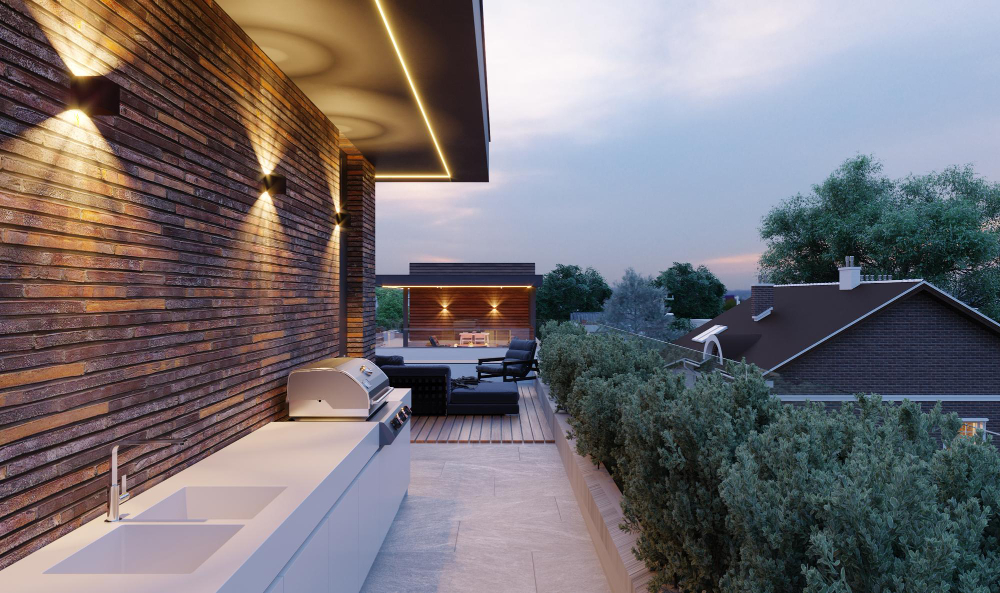
A retaining wall that disappears after sunset is a grade change nobody can see, and grade changes are where people fall. Lighting fixes that before it does anything decorative. We build and light terraced yards as a local outdoor living contractor serving Denver, CO and the surrounding metro, so the safety side is handled by the same crew that sets the block.
The lighting conversation happens during design, while the wall is still a drawing. Our crews run conduit and sleeves through the wall as it goes up, since cutting a channel into finished block later is slower and uglier. Walk your own yard after dark once and the problem usually announces itself within a minute.
A Dark Wall Is a Trip Hazard Before It Is Anything Else
The risk on a terraced yard is depth perception. A wall reads as a flat surface at night, so the drop at the top edge and the step at the bottom both vanish. Guests heading back from a fire pit are the usual casualties, often carrying something and rarely watching their feet. Light aimed at the right surfaces restores the edges, and the brain does the rest.
That changes how we aim fixtures. Decorative lighting flatters the stone face, while safety lighting marks where the ground changes height. A wall lit only across its face can make things worse. A bright vertical plane pulls the eye up and leaves the tread in shadow. The goal is simple enough: see the ground you are about to stand on. The wall becomes attractive as a side effect of doing that well.
Lighting Types That Hold Up Outdoors in Colorado
Low voltage systems dominate residential hardscape work for good reason. They run at twelve volts off a transformer, and the cable can be buried shallower than line voltage. A homeowner can add a fixture later without an electrician on site. Integrated LED fixtures last long enough that the lamp is rarely the thing that fails.
Durability here is about more than lumens. Front Range yards swing through freeze and thaw repeatedly across a single winter. Water that works into a cheap housing freezes and splits it. Sealed brass and copper fixtures handle that cycle and age into a patina rather than flaking. Solar fixtures remain tempting and remain disappointing on north facing terraces. Shorter winter daylight and snow cover leave them dim exactly when the yard is darkest. If a path has to be safe every night, it needs a wired circuit behind it.
Have terrace steps that vanish once the sun drops behind the foothills, and an association with lighting guidelines to satisfy? Give us a call at (720) 821 0467, and we will work out what clears the rules and still puts light on the ground.
Where the Light Belongs on a Terraced Yard
Placement is the part homeowners most often get wrong. The usual mistake is lighting the prettiest surface and leaving the functional ones dark. Working through the yard as a route rather than a set of features tends to sort it out. Start where someone enters the space, then follow the path they actually walk.
- Under the wall cap, washing light downward across the face and onto the ground at the base
- At every step and tread in a terraced run, lit from the side or recessed into the riser
- At the top edge where the drop begins, so the boundary reads clearly from above
- At turns and corners, which are where people misjudge distance in low light
- Near any seating wall that doubles as a bench, since people sit down without looking
Four well placed fixtures beat a dozen scattered ones. Overlighting flattens the yard and kills the shadow that gives a wall its depth, and it costs more to run. Terraced yards benefit most of all. Our write up on multi level patio and terracing ideas shows how those levels get planned. They work as one circulation route, not a stack of separate walls.
Wiring Goes In Before the Wall Does
Sequencing is the quiet cost saver on this work. Sleeves through the wall, conduit behind it and an early transformer location all cost very little while the wall is open. Retrofitting the same run into a finished wall means pulling cap stones and chasing a channel. You then hope the drainage layer behind the block stays intact.
Drainage is why we stay careful, since a retaining wall relies on free draining backfill and a pipe at the base. A cable trench cut carelessly into that zone undermines the thing the wall was built to do. Fixture locations should be marked during design, not discovered during installation.
We plan them alongside the drainage and the geogrid so the wall keeps working as a structure. The retaining walls we build come with that soil and drainage evaluation as part of design, which is the stage where lighting is easiest and cheapest to get right.
Glare, Neighbors and Community Rules
Aim matters as much as placement. A fixture tilted even slightly upward throws light into a neighbor’s window. It also hits the eyes of anyone walking toward it, which defeats the safety purpose entirely. Shielded fixtures and a downward throw keep the light on the ground where it belongs.
Many communities across Denver, CO regulate exterior lighting. Some do it through architectural guidelines and others through municipal dark sky provisions. Fixture style, color temperature and brightness can all be covered. Height, setback and approval rules also shape where power can reasonably go. Roughly 85 percent of the homeowners we work with need approval from a community association. We prepare and submit that documentation on their behalf, so the lighting plan clears at the same time as the wall.
Maintenance Through Freeze and Thaw
Hardscape lighting asks little, though the little it asks is seasonal. Fixtures near the base of a wall collect leaf litter and splash. A lens coated in mineral haze loses a surprising amount of output. A rinse and a wipe twice a year restores most of it.
Snow is the other factor, since fixtures sitting low in a terrace get buried and then shoveled against. Mounting them slightly proud of the mulch line, or recessing them into the riser, keeps them clear. Check connections in spring, once heaving ground has had a winter to loosen a stake or stress a splice.
Confirm the transformer still matches the load if fixtures have been added along the way. Wall movement is a separate matter, and the height and drainage decisions covered in our guide before building retaining walls are what keep it from starting, which is worth settling with our team before the first course is set.
Frequently Asked Questions
Can lighting be added to a retaining wall that’s already built?
Yes, but it takes more work. Retrofitting means pulling cap stones and cutting a channel without damaging the drainage layer behind the block. Planning the wiring while the wall is going up costs far less and keeps the wall working as a structure.
Are solar lights good enough for a retaining wall?
Not where safety matters. Short winter days and snow cover leave solar fixtures dim exactly when the yard is darkest, especially on north facing terraces. If a path needs to be safe every night, it needs a wired low voltage circuit behind it.
Do I need HOA approval for retaining wall lighting?
Often, yes. Many Denver area communities regulate fixture style, color temperature and brightness. About 85 percent of the homeowners we work with need association approval, and we prepare and submit the paperwork so the lighting plan clears along with the wall.
How much maintenance does wall lighting need?
Very little. Rinse and wipe the lenses twice a year to clear mineral haze and leaf litter. In spring, check stakes and connections after the ground has heaved through winter, and confirm the transformer still matches the load if you’ve added fixtures.
The right lighting shows every step and edge after dark, and it makes your walls look their best at the same time. Denver Patio Masters plans the wall, drainage and fixture runs as one project, so everything goes in right the first time. Call (720) 821 0467, and get free on site consultation, with no obligation to move forward.