

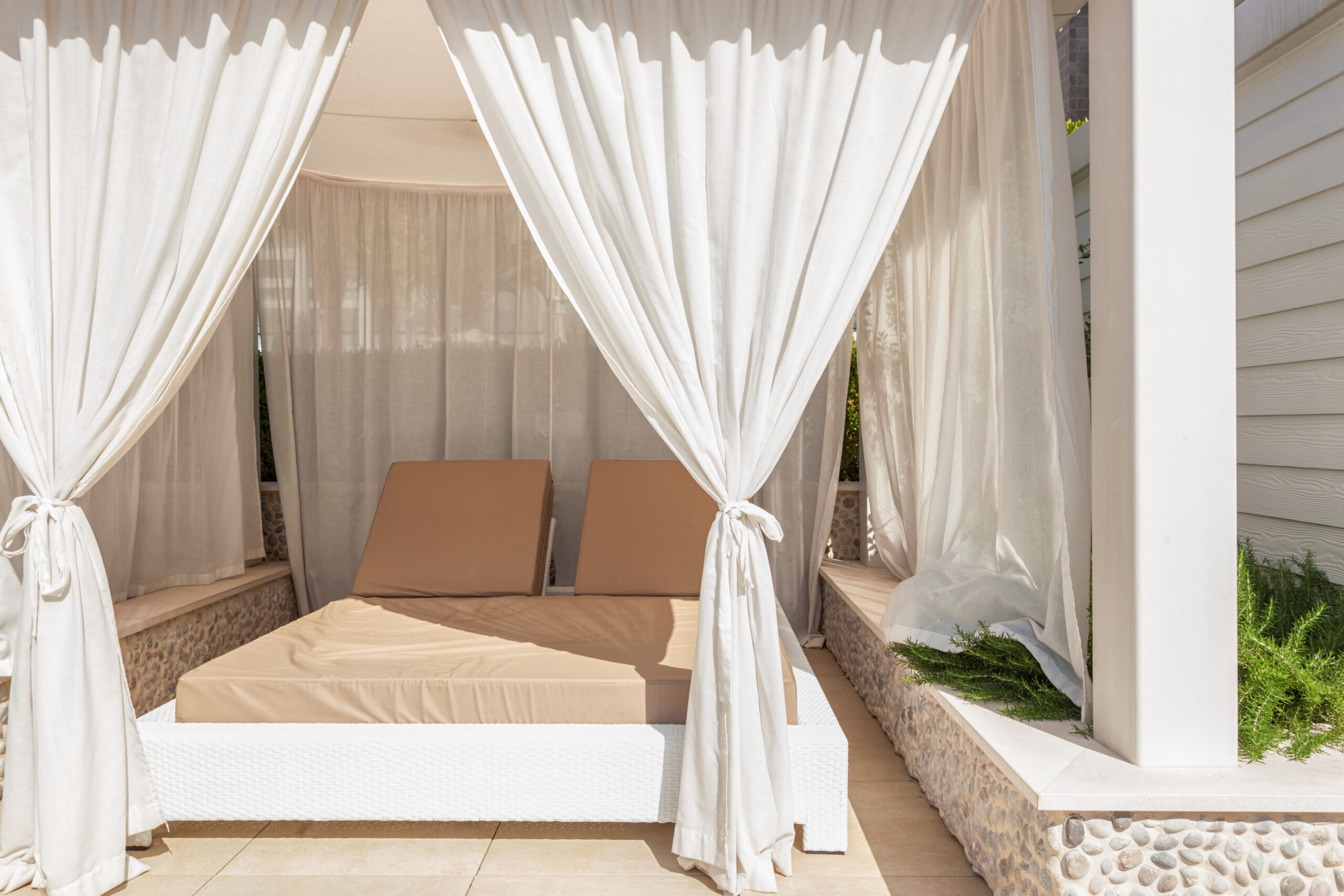
Four add-ons carry most of the seasonal gain on a Colorado pergola: curtains or screens that stop wind, overhead radiant heat, a solid or louvered roof section over part of the span, and lighting that keeps the space usable after dark. Wind ends more evenings here than temperature does, so screens often earn their place before a heater does.
We build pergolas across the Denver metro as a family-owned local patio contractor in Denver, CO, and we plan these add-ons during the free design consultation, while the posts and beams are still on paper. A heater bolted to a beam that was never sized to carry it is a retrofit, not a design. Ask whoever quotes your project to show you where the power runs and where the fasteners land before any footing gets poured.
Which pergola add-ons actually extend the season, and in what order?
Order them by what drives you indoors. On the Front Range, that is usually moving air, then radiant heat loss after sunset, then rain or snow load, then darkness. Screening the windward side of a pergola changes the felt temperature under it more than any single heater will, because a heater warms objects while wind strips that warmth away as fast as it arrives. Homeowners who screen one or two sides first and add heat second tend to get more use out of a smaller budget.
Roof treatment sits third because it changes what the structure is rather than how it feels. An open-slat pergola gives dappled shade and no rain protection, so adding a solid panel over the dining half converts part of the span into something closer to a patio cover while the rest stays open. Lighting sits last in cost and first in daily impact, since an unlit pergola empties out at dusk no matter how warm it is. We tend to sequence a project in that order when a homeowner wants to phase the spend across two seasons.
Do outdoor curtains make a pergola warmer, or just more private?
Both, and the privacy is usually the reason people buy them, while the wind block is the reason they keep them. Fabric panels on a track or cable stop lateral airflow through the structure, which is what makes a 55-degree evening feel survivable in a sweater instead of sending everyone inside. They also cut low-angle western sun, which in Colorado arrives hard enough in late afternoon to make a west-facing seating area unusable for an hour or two.
The trade-off is maintenance and wind loading. Panels left out through a gusty spring take a beating, and a curtain that cannot be tied back or retracted becomes a sail that pulls on whatever it is attached to. Solution-dyed acrylic and marine-grade fabrics hold color better under the UV intensity at this elevation than cheaper woven goods, and any panel system worth installing has a way to secure or remove it fast.
Ask for the fabric’s UV rating and the manufacturer’s wind guidance in writing, then decide whether you want the panels on all four sides or only the two that catch weather. Most of the pergolas we build end up screened on one or two sides, not enclosed.
What kind of pergola heater works best in Denver evenings?
Radiant heat works, and convective heat mostly does not, because convection depends on holding a pocket of warm air that an open structure cannot hold. Overhead electric infrared units mounted to the beam structure warm people and surfaces directly, run without a flame, and stay out of the furniture layout. Freestanding propane units put out more heat per dollar but occupy floor space, need tank storage, and blow out of usefulness in real wind.
Mounting is where the planning pays off. Electric infrared draws real current, so the circuit, the conduit path, and the switch location belong in the electrical plan alongside the lighting, not in a follow-up conversation with an electrician a year later. Gas appliances at Denver’s elevation can also need pressure adjustments to fire correctly, which is worth confirming with the installer before a line is run.
We size beams and run conduit during the build when a homeowner tells us heat is coming, even when the heaters themselves are a phase-two purchase. That is the cheapest version of this decision you will ever get.
How much structure does a pergola need before you add anything to it?
More than a bare shade frame, and this is the part homeowners find out about late. Every add-on loads the structure differently. Curtains apply lateral pull at the attachment points. Overhead heaters add dead weight and require clearance from anything combustible. A solid or louvered roof panel adds snow load, which on the Front Range is the number that governs, and it changes how wind moves across the top of the frame.
A pergola designed for those loads from the start uses different post sizing, different footings, and different beam connections than one designed only to hold slats. Retrofitting is possible but rarely clean, and it sometimes means opening up finished surfaces to reach a footing. The custom pergolas our team at Denver Patio Masters builds are designed around the finished version of the space rather than the opening-day version. When you compare quotes, ask each contractor what snow load the structure is designed for and what the beams can carry, and treat a vague answer as an answer.
Before we finalize a pergola design, we ask homeowners to settle these five things:
- Which sides catch the wind and the late sun, based on how the yard actually behaves
- Whether heat will be electric, gas, or none, since that decides the rough-in
- Whether any part of the span needs to shed rain and snow
- Where the light switches and outlets should sit for how the space gets used
- Whether a fire feature, kitchen, or seating wall is coming later
If you can answer those, you are ready for a design appointment rather than a browsing conversation. Our free design consultation happens at your home, with measurements taken on site, and you leave with a design and an estimate rather than a ballpark.
Not sure which side of your Denver yard actually catches the wind, or whether your roofline will even clear a beam? Give us a call at (720) 626-4010, and we’ll walk the site with you before anything gets designed.
What does a partial roof or adjustable louver do to summer use?
It fixes the complaint people do not anticipate, which is that an open pergola is pleasant in June and punishing at two in the afternoon in July. Dappled shade from fixed slats moves across the space as the sun tracks, so the table that was shaded at noon is in full sun by three. Adjustable louvers let you close the slats during peak sun and open them when you want light, which turns a single structure into two different spaces.
A solid panel over part of the span does something different again. It creates one zone that stays dry and shaded through a summer storm and one that stays open to the sky, which suits households that want to eat outside in the weather but still want sun on the lounge chairs. The same panel keeps furniture and any outdoor rug out of the worst of the UV, and it protects mounted electronics and heaters from direct precipitation.
Homeowners weighing motorized and sensor-driven versions of this can compare the tradeoffs in our write-up on smart patio covers, which covers what automation does and does not solve.
When do pergola add-ons need HOA approval in Denver metro communities?
More often than people expect, because most HOA architectural rules are written around permanent structures and visible changes rather than around the word “pergola.” A freestanding frame usually triggers review. Adding a solid roof section, changing the roof profile, or mounting anything that alters the silhouette can trigger a fresh submission even when the original structure was already approved. Curtains and lighting are treated inconsistently from one community to the next, and some associations regulate color and fabric visibility.
Roughly 85 percent of our customers need HOA approval, and our team handles that submission on their behalf. Compiling placement documentation, material specifications, and elevation details in the format a given board expects is most of the battle, and applications usually stall on missing detail rather than on the design itself.
Pull your covenants before you shop, since knowing whether solid roofs are permitted in your community changes which pergola you should be pricing. If the structure itself is still up in the air, this pergola style guide walks through how modern and traditional profiles read against different Denver home styles.
What does it cost to add these later instead of now?
More, and the gap is mostly labor and access rather than materials. Running conduit through an open frame during construction is quick. Fishing it through a finished beam, or trenching to a structure that now sits behind a completed paver surface, is a different job. The same applies to gas: a line stubbed during the build is routine, while a line run after the patio is finished may mean cutting and resetting surface material.
There is also a design cost that does not appear on an invoice. Add-ons chosen after the fact tend to look added, because the mounting points, the switch locations, and the fabric hardware were never part of the original lines. Planning the finished version up front and phasing the purchases is almost always cheaper than phasing the construction.
Financing is available for homeowners who would rather build the full design at once, including advertised 0 percent interest options subject to credit approval, and the terms are worth reading before you sign anything.
Frequently Asked Questions
Can a pergola be enclosed completely with curtains?
It can be screened on all four sides, but full enclosure changes the structure’s classification in most jurisdictions and often in HOA rules as well. Panels that retract or tie back keep the structure reading as a pergola while still blocking weather. Confirm with your local building department how your community treats a fully enclosed outdoor structure before you commit to that design.
Do pergola heaters work when it is below freezing?
Radiant heaters keep people comfortable in cold air as long as wind is controlled, which is why screening matters as much as wattage. Below freezing, expect a usable seating zone directly under the units rather than a uniformly warm space. Households that want reliable winter use are usually better served by a covered structure than by adding more heat to an open frame.
Will adding a solid roof section require a permit in Colorado?
Permit requirements vary by city and by what you are building. Permanent roofed structures commonly require a permit while open slat frames sometimes do not, and the threshold differs across Denver metro jurisdictions. Check with your local building department for your specific address, or ask us to confirm it during the design consultation.
Can add-ons be installed on a pergola somebody else built?
Sometimes, depending on how the existing frame was sized and footed. Our team inspects the structure before quoting any retrofit, since attaching heat or curtain hardware to undersized beams creates a safety problem rather than an upgrade. Where the existing frame cannot carry the load, we will say so rather than mount to it.
What is covered by the lifetime warranty on a pergola build?
We offer a lifetime warranty on completed work. Coverage specifics depend on the project, so ask for the written warranty document that applies to your build and read the terms before signing, which is advice worth following with any contractor you consider.
Reach our team at (720) 594-0235, Monday through Sunday from 9:00 AM to 5:00 PM, or visit our contact page to schedule a free design consultation.
Ready to plan the finished version of your pergola?
Bring us the yard as it is and tell us how you want to use it in October, not just in July. We will measure on site, design around the wind and sun your property actually gets, and give you an estimate that reflects the whole build, whether you put it in at once or in phases. Denver Patio Masters serves Centennial, Denver, Aurora, Highlands Ranch, Littleton, Parker, and the surrounding Denver metro communities.
Denver Patio Masters, 8200 S Quebec St, Suite A3703, Centennial, CO 80112. 855-CO-PATIO or 720-594-0235. Open Monday through Sunday, 9:00 AM to 5:00 PM