

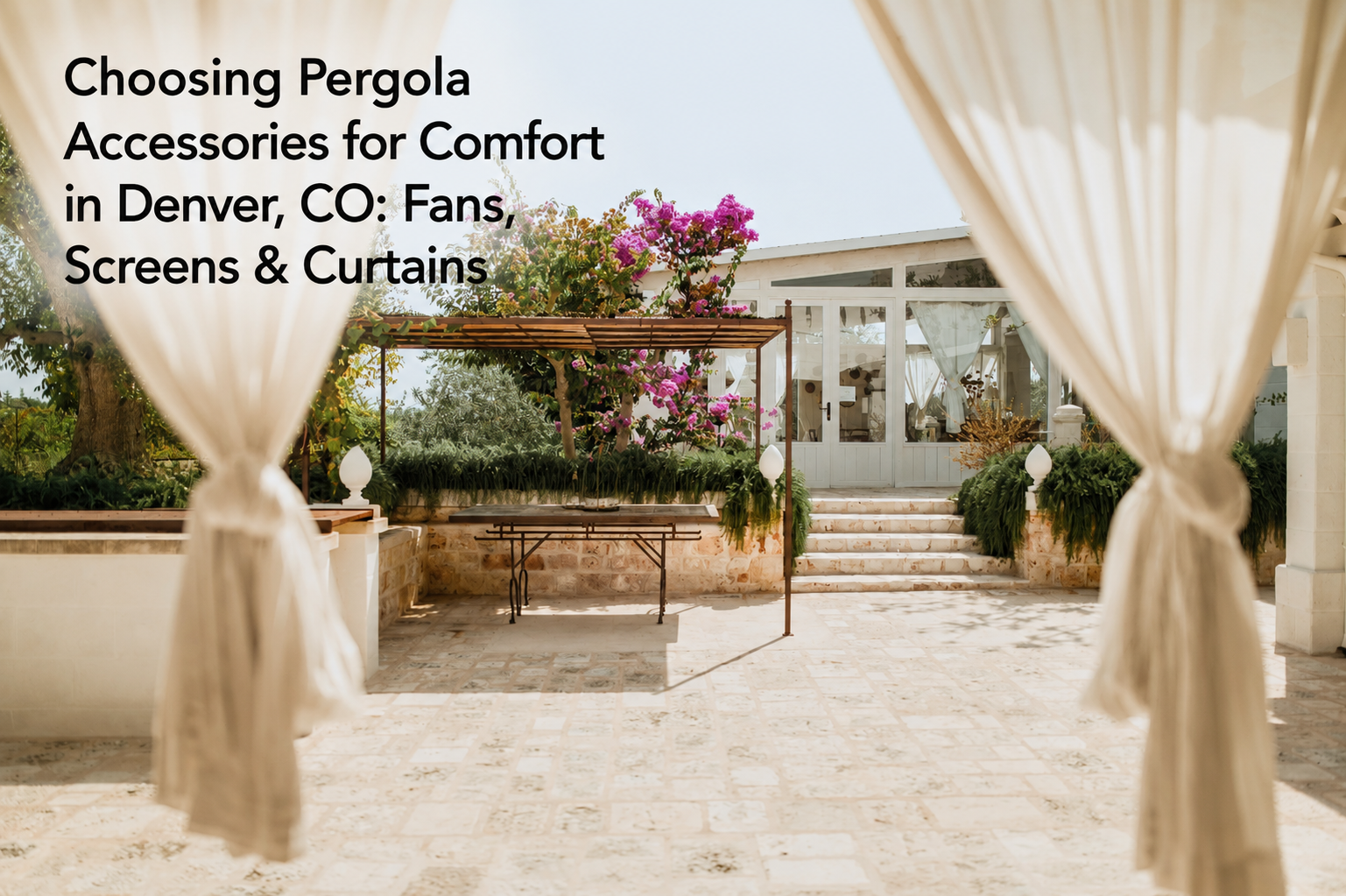
A pergola gives your backyard structure and shade, but without the right accessories, it still leaves you dealing with Colorado’s harsh afternoon sun, mosquitoes, and seasonal gusts. Fans, screens, and curtains each address a different layer of discomfort, and the right combination can add hours to your day and months to your season of outdoor use. A reputable patio contractor in Denver, CO can help you pick pieces that hold up to local weather, and this guide answers the questions Denver homeowners ask most often when outfitting a pergola for real-world comfort.
What Accessories Can You Add to a Pergola?
Pergola accessories fall into three practical categories: air movement, enclosure, and privacy. Ceiling fans handle air movement, keeping the space comfortable on hot afternoons. Screens handle enclosure by keeping insects out and filtering light from specific directions. Curtains add privacy and directional shade with more flexibility than screens, since they can be tied back when conditions are good and drawn closed when they are not.
Beyond those three, some homeowners add retractable shade sails above the pergola frame, string lights for evening use, or slatted side panels for wind and sun control. The right combination depends on how the pergola is oriented, what time of day the space gets the most use, and what the HOA permits in the specific community.
Do Outdoor Ceiling Fans Work on a Pergola?
Outdoor ceiling fans are one of the most practical upgrades for a Denver pergola, and they work well when the right model is selected for the conditions. Colorado summers bring intense afternoon sun and temperatures that climb quickly, particularly in south-facing backyards. A fan rated for outdoor use keeps air moving across the space and makes it feel meaningfully cooler without any mechanical cooling system.
The rating matters. Fans in covered outdoor spaces need to be “damp-rated” at minimum. Fans on fully open pergolas that are exposed to rain or blowing moisture should be “wet-rated.” Denver’s afternoon thunderstorms arrive fast and can drench a partially covered space in minutes, so a wet-rated fan is the more reliable long-term choice even when the pergola roof provides some overhead coverage.
Mounting also requires planning ahead. The beam or header the fan attaches to needs to be solid enough to handle the weight and vibration. Electrical wiring is the other variable: running conduit during the pergola build costs far less than cutting into finished work after the structure is complete.
Are Pergola Screens Worth It in Colorado?
Pergola screens serve two purposes that Denver homeowners consistently rank as priorities: shade control and insect management. The mosquito population along the Front Range is active enough in late summer that many homeowners who built without screens find the space difficult to use in the evenings from July through September.
Retractable screens are the most popular choice because they disappear when the weather is perfect and deploy when needed. Fixed screens are less expensive but stay in place year-round, which changes the visual openness of the pergola even on days when full airflow would be preferred.
Shade screens are a separate product designed to reduce solar heat gain rather than block insects. They filter light without fully enclosing the space, which works well on south and west-facing sides of a pergola where afternoon sun hits hardest. In communities like Highlands Ranch or Centennial where many backyards face southwest, shade screens on the sun-facing sides make a noticeable difference in comfort from mid-afternoon onward.
In HOA communities, screen colors often need to match community standards, and some HOAs require screens to be retractable rather than fixed. Our team manages all HOA paperwork for our clients, so accessory-related submissions are handled as part of the project process when needed.
Can You Add Curtains to a Pergola?
Outdoor curtains are one of the most flexible pergola additions because they can be installed at any stage, adjusted seasonally, and taken down for winter without any structural impact on the pergola frame. They add privacy from neighboring yards, break the afternoon wind that moves through many Denver suburbs, and soften the look of the space when drawn.
Fabric selection matters more in Colorado than in most of the country. Denver sits at 5,280 feet of elevation, and UV intensity at altitude is higher than at coastal or Midwest locations. Standard polyester outdoor fabric fades noticeably within a season or two. Solution-dyed acrylic fabric, commonly used in marine-grade outdoor applications, holds color far longer and resists moisture without mildewing. It costs more than polyester alternatives but outlasts them by years under Colorado sun.
Hardware needs to be outdoor-rated as well. Powder-coated aluminum or stainless steel curtain rods and track systems hold up far better than painted steel alternatives in Colorado’s climate, which swings between summer heat and winter freeze with regularity. The mounting points are easiest to plan into the pergola beam or post from the beginning of the project rather than adding them later.
How Do You Combine Fans, Screens, and Curtains for Maximum Comfort?
Layering accessories gives a pergola the range to handle different conditions throughout the day and across different points in the Colorado season. A practical approach for most Denver homeowners: a ceiling fan for daily air circulation from May through September, retractable screens on the yard-facing sides for evening insect control, and curtains on the west or southwest side for afternoon sun and wind management.
The order of installation matters when planning ahead. Fan wiring should be designed before the pergola ceiling structure is finalized. Screen track mounting points are easier to integrate before adjacent fencing or planters are completed. Curtain hardware can generally be added at any stage, making curtains the most flexible of the three to add at a later phase.
Planning accessories during the original pergola design phase is the most cost-effective approach. Our team factors accessory integration into every pergola design consultation, including wiring placement, screen track mounting, and HOA requirements for each accessory type.
Will Your HOA Allow Pergola Accessories in Denver?
Most Denver metro HOAs allow pergola accessories, but the specific requirements vary enough between communities that checking before installation is worth doing. Common HOA restrictions around accessories include color matching requirements for screens and curtains, retractability requirements, and height restrictions on any mounted hardware that extends above the pergola frame.
About 85% of our clients are in HOA communities across the Denver metro, including Centennial, Highlands Ranch, Parker, Lone Tree, and Castle Pines. We handle all HOA paperwork and approval submissions on behalf of our clients, which includes accessory-related submissions when the project scope requires it. If you are planning to add screens, curtains, or other accessories to a new or existing pergola, we can advise on what needs HOA sign-off during the consultation.
Why the Pergola Structure Determines What You Can Add
The accessories you add to a pergola can only work as well as the structure they are mounted to. A pergola frame that was underbuilt or not sized for Colorado’s snow loads and wind exposure may not safely support ceiling fans, motorized screen systems, or heavy curtain track hardware without modification.
Our pergola installations are built with beam sizing and post footings designed for Colorado conditions, including snow load requirements and the UV degradation that wood structures experience at altitude. Aluminum pergola systems hold up particularly well in Colorado because they do not warp, rot, or require refinishing the way wood does over a 10 to 15-year period. If you have an existing pergola and want to add accessories, we can assess the structure during a consultation to confirm whether reinforcement is needed before any hardware is mounted.
Why Denver Homeowners Choose Us for Pergola Projects
We have been building outdoor living spaces across the Denver metro area since 1990. Our team holds active Colorado contractor licenses, D20023 for concrete and D1090 for framing, and backs every project with a lifetime warranty. That warranty applies to our pergola work the same as it applies to every other service we provide. If something fails, we come back and fix it, and no other patio contractor in the Denver area makes that commitment.
Our Google rating is 4.8 stars across 194 verified reviews. We were also recognized as the Best Outdoor Living Contractor in Denver Metro for 2025. Beyond pergolas, we build the full range of outdoor living spaces, including concrete patios, stamped concrete, paver patios, patio covers, fire pits, outdoor kitchens, and retaining walls. If the pergola is part of a larger backyard plan, we handle the full build under one contract.
Frequently Asked Questions
What type of ceiling fan is best for an outdoor pergola in Denver? A wet-rated fan is the most reliable choice for Denver pergolas, even when the pergola roof offers some overhead protection. Denver’s afternoon thunderstorms arrive quickly and can expose a partially covered space to blowing rain within minutes. Look for a motor sealed against moisture and blades rated for outdoor conditions. Longer blades at a steeper pitch move more air at lower speeds, which is more practical for outdoor use than small, fast-spinning models.
How much does it cost to add screens to a pergola? The cost depends on the number of sides being screened, whether the system is fixed or retractable, and the material selected. Motorized retractable screens cost more than manual or fixed options but offer the flexibility that most homeowners prefer for year-round use. Because pergola dimensions and configurations vary, exact pricing requires an in-home assessment, and we provide a written estimate at no charge.
Do pergola curtains hold up to Colorado winters? Outdoor-rated curtains made from solution-dyed acrylic fabric handle Colorado weather better than polyester alternatives, but most homeowners take them down before winter to extend their lifespan. Ice loading from winter storms and high UV from Colorado’s intense sun both shorten how long curtains last when left up year-round. Seasonal removal is straightforward since most outdoor curtain systems are designed for it.
Can accessories be added to an existing pergola? Yes, in most cases. The key question is whether the existing frame is solid enough to support the added hardware, particularly for ceiling fans and motorized screen systems. We can assess an existing pergola during a consultation to determine whether any reinforcement is needed before accessories are mounted.
Will pergola accessories affect my HOA approval in Denver? They can, depending on the community. Some HOAs require that screens and curtains be retractable rather than fixed and that colors stay within community-approved palettes. If accessories are part of a new pergola project, we include them in the HOA submission. If you are adding them to an existing structure, we can advise on whether a separate submission is required.
What is the most cost-effective first accessory to add to a pergola? For most Denver homeowners, a ceiling fan delivers the most immediate daily comfort return. It requires minimal structural modification and provides direct benefit from spring through fall. Screens are the next priority for most homeowners, particularly for evening use when insect activity is highest.
Contact Us
Need help designing or building your dream outdoor space? Reach out to Denver Patio Masters, Colorado’s patio and outdoor living specialists.
Address: 8200 S Quebec St, Suite A3703, Centennial, CO 80112
Phone: (720) 594-0235
Email: info@denverpatiomasters.com
Business Hours: Monday–Sunday: 9:00 AM–5:00 PM
Whether you’re ready to start a project or want a free consultation, give them a call, send an email, or visit their contact page to connect with the team and begin transforming your outdoor living space.
Related Topics: