

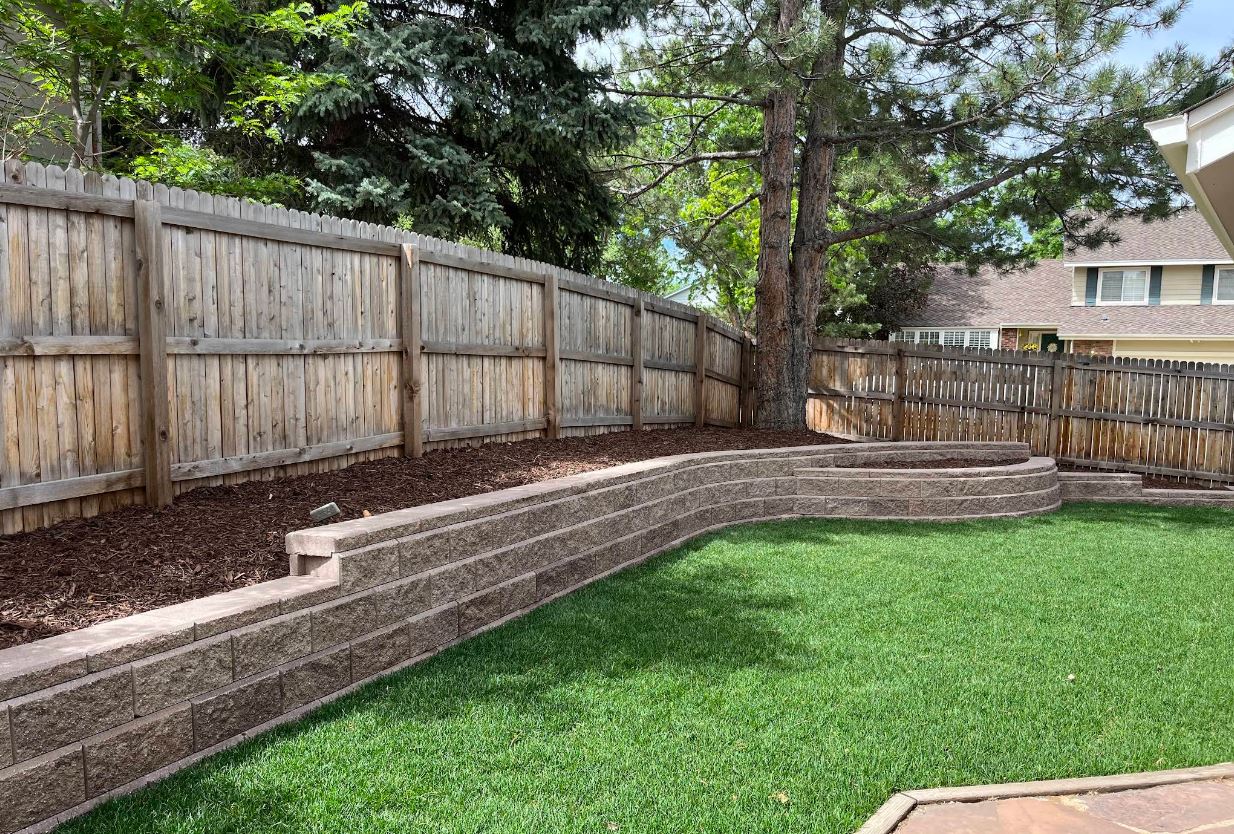
Most retaining wall problems in Denver do not start with the wall itself. They start with the drainage behind it. As a trusted full-service patio contractor serving the Denver metro area, Denver Patio Masters approaches every retaining wall project knowing that materials alone are never enough.
Our dedicated patio professionals factor drainage into the design from day one, because a wall built without it will lean, crack, or collapse as Colorado’s freeze-thaw cycles push relentless pressure against the soil behind it. Getting both elements right from the start is what separates a retaining wall that holds for decades from one that needs repairs just a few years after it goes in.
Why Colorado’s Climate Makes Retaining Wall Design Different
Colorado presents specific challenges that make retaining wall construction more demanding than in many other parts of the country. The freeze-thaw cycle is the primary factor. Throughout the winter and into early spring, soil behind a retaining wall alternates between freezing and thawing repeatedly. Each freeze causes the soil to expand and push against the wall. Each thaw allows water to settle and shift the soil further. Over time, without proper drainage, that pressure accumulates and the wall begins to move.
Beyond the freeze-thaw cycle, Colorado’s heavy spring snowmelt adds a significant volume of water to the soil in a short period. A wall without adequate drainage can become saturated quickly, increasing the load it has to carry. Designing for that drainage capacity upfront is the only reliable way to prevent long-term structural problems.
Concrete Block Retaining Walls
Concrete block is the most widely used material for residential retaining walls in the Denver metro area, and for good reason. It is durable, cost-effective, available in a range of finishes and colors, and well-suited to Colorado’s climate when installed with a proper base and drainage system.
Segmental retaining wall blocks are engineered to lock together and create a structured face that handles lateral soil pressure. The blocks are laid in a battered pattern, meaning they angle slightly backward, to help counteract the force from the soil behind the wall. Combined with compacted gravel backfill and drainage pipe, a concrete block wall built to standard specifications performs well through Colorado winters for many years.
This material is a practical choice for most residential slopes in Centennial, Parker, Highlands Ranch, and across the Denver metro area. It holds up well, offers design flexibility in terms of color and texture, and can be built to significant heights when properly engineered.
Natural Stone Retaining Walls
Natural stone brings a different visual quality to a retaining wall, and for homeowners who want the texture and character of real stone, it is worth the higher labor cost involved. Fieldstone, flagstone, and dry-stacked boulders all create walls with a natural appearance that integrates well with Colorado’s landscape aesthetic.
The trade-off compared to concrete block is consistency. Natural stone varies in size and shape, which means each piece has to be selected and placed individually for the wall to be structurally sound. This takes more time and skill than laying manufactured block, and that labor shows up in the project cost.
Dry-stacked stone walls allow water to pass through the wall face naturally, which can reduce the pressure buildup behind the wall. They are generally limited to lower heights without mortar or a reinforced footing, however. For taller walls on significant slopes, concrete block or a combination approach is typically the more reliable structural choice.
Paver Retaining Walls
Paver retaining wall systems offer a high-end finished look that pairs naturally with a paver patio surface. Manufacturers like Belgard and Unilock produce retaining wall units specifically engineered to work with their paver lines, so the wall and patio surface can share a consistent material and color palette.
For homeowners building a paver patio on a sloped yard, designing the retaining wall with matching paver materials creates a cohesive finished space rather than a visible contrast between two different systems. The wall becomes a design element rather than a purely structural feature.
These systems handle freeze-thaw conditions well when properly installed with the right base and drainage behind them. The individual units can also be removed and reset if any section shifts over time, which is a practical advantage over a poured concrete wall where repairs are more involved.
Drainage: The System That Protects the Wall
The drainage system behind a retaining wall is where most long-term problems either start or get prevented. Three elements make up a standard drainage design: compacted gravel backfill directly behind the wall, a perforated drainage pipe at the base to collect and redirect water, and either weep holes through the wall face or pipe outlets to allow water to exit.
Without these elements working together, water accumulates in the soil behind the wall. In Colorado, that means saturated soil freezes solid in winter, expands, pushes against the wall, and puts repeated stress on the base over multiple seasons. Over enough freeze-thaw cycles, even a well-built wall will show movement.
The depth of the drainage aggregate, the pipe diameter, and the outlet placement all depend on the size of the wall, the volume of water the slope handles during snowmelt and rain events, and the soil type behind the wall. These details are part of the planning conversation before any construction begins.
Base Preparation for Colorado Freeze-Thaw Conditions
The base of a retaining wall needs to sit below the frost line to prevent heaving. In the Denver metro area, the frost depth is generally around 36 inches. A wall base that sits above that level is vulnerable to lifting and shifting as the ground freezes and thaws each season, which shows up as visible movement in the wall face.
Compaction carries equal weight. The gravel or crushed stone base beneath the wall needs to be mechanically compacted to provide a stable, consistent surface for the first course of block or stone. A poorly compacted base allows the wall to settle unevenly over time.
These base requirements mean more excavation and preparation work than a visible look at the slope might suggest. A slope that appears to be a simple retaining wall job often involves significant base work before the first block is set in place.
When a Retaining Wall Is the Starting Point, Not an Add-On
On sloped yards in Denver suburbs, a retaining wall is often not optional. If the yard drops away from the house by more than a foot or two across the intended patio footprint, a retaining wall needs to be built first to create a level surface for the patio. The wall is not an extra cost; it is the foundation that makes the rest of the project possible.
A homeowner in Parker with an 18-inch drop across 20 feet of intended patio space needs that grade addressed before any concrete can be poured or pavers can be laid. Skipping the retaining wall and working around the slope produces a patio surface that drains poorly and creates ongoing maintenance problems.
When we assess a property for a patio project, we flag any slope conditions that require a retaining wall as the first step. That conversation happens during the free consultation, before anything is priced or scheduled.
How We Approach Retaining Wall Projects
Our team designs and builds retaining walls as standalone projects and as part of full outdoor builds that include patio surfaces, pergolas, and other features. Every wall we build is backed by our lifetime warranty, which covers workmanship on the finished installation. We are the only patio contractor in the Denver area offering this coverage.
We hold a 4.8-star Google rating across 194 verified reviews and serve homeowners across Centennial, Parker, Highlands Ranch, Lone Tree, Aurora, and throughout the Denver metro and Colorado Springs area.
Related Topics: